
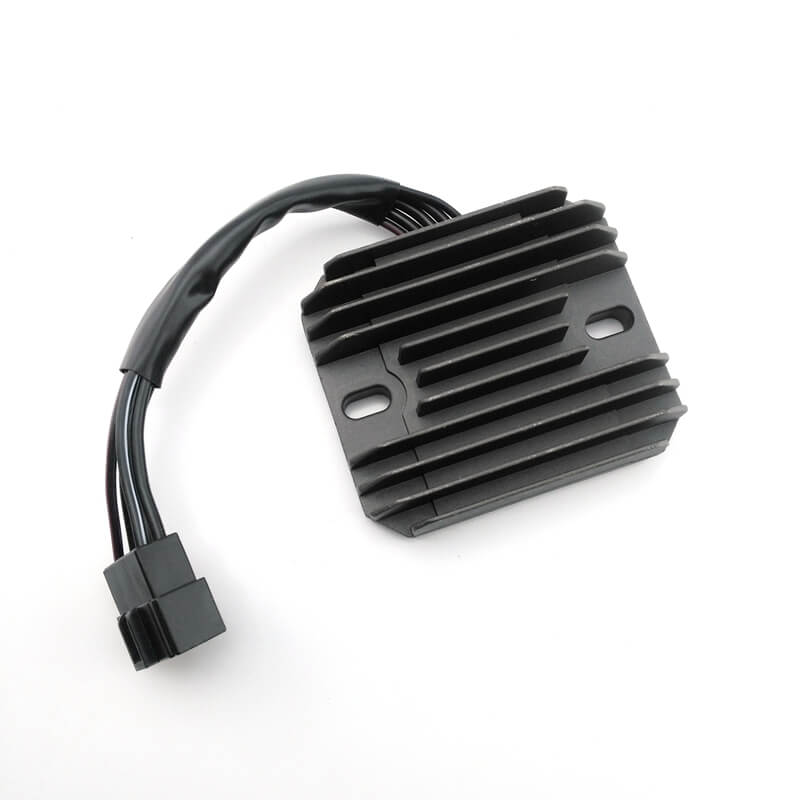
The motorcycle voltage regulator (referred to as the regulator) is an essential component that plays a crucial role in stabilizing the battery voltage of the motorcycle. Its principle is to use a voltage stabilizing diode or voltage regulator IC to convert the alternating current (AC) generated by the magnetic generator into stable direct current (DC) through rectification. This ensures that the motorcycle battery voltage remains within an appropriate range.
Here’s a breakdown of how the voltage regulator works:
- AC to DC Rectification: The motorcycle’s generator (usually a magnetic generator) produces alternating current (AC). This current is passed through the regulator’s rectifier components, which convert it into direct current (DC), as motorcycle batteries require DC for charging.
- Voltage Regulation: The rectified DC current can fluctuate due to changes in the engine’s RPM. Without regulation, this fluctuation could result in overcharging or undercharging of the battery. The regulator uses voltage stabilizing components (like zener diodes or integrated circuits) to maintain the voltage within a safe range, typically between 13.5V and 14.5V, which is ideal for most motorcycle batteries.
- Battery Protection: If the voltage rises too high, the regulator will divert the excess current to the ground through its control circuitry, preventing overcharging of the battery. Conversely, if the voltage drops too low, the regulator will ensure that the battery continues to receive charge, preventing undercharging.
Modern voltage regulators often include additional features like temperature monitoring and overload protection to provide more precise and secure voltage control.
In short, the motorcycle voltage regulator acts as a “guardian” of the electrical system, ensuring that the battery consistently provides stable power for the smooth operation of the motorcycle. If the regulator fails, it can lead to overcharging or undercharging of the battery, potentially damaging it and affecting overall vehicle performance.